Black Lace Amen PNG, Christian PNG
A First Look: Delicate, Devout, and Designed for Meaning
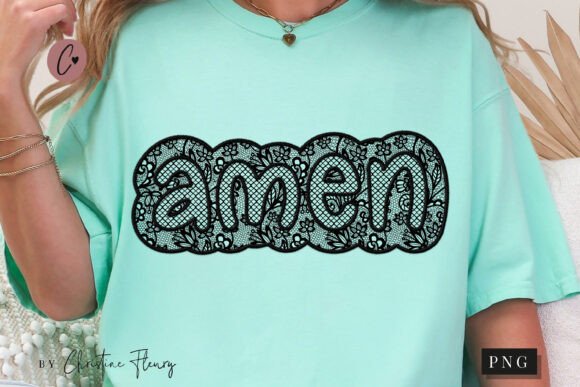
When I opened Black Lace Amen PNG, Christian PNG, I didn’t just see a design—I saw intention. The lace motif wraps the word “Amen” like a quiet benediction: fine, openwork lines, soft curves, and balanced negative space. It’s not flashy or ornate in a decorative sense—it leans into reverence, not ornamentation. That matters. For a T-Shirt Designs category item, this isn’t built for loud streetwear energy. It’s made for the embroidered tote bag you hand-stitch for a church volunteer, the pillow cover gifted after a baptism, or the baby onesie that whispers faith instead of shouting it. Its visual personality is hushed confidence—elegant enough for boutique branding, humble enough for handmade product authenticity.
Where It Shines: Real Projects, Real Impact
I tested Black Lace Amen PNG, Christian PNG across three real-world uses: a medium-weight cotton canvas tote, a 100% cotton crewneck sweatshirt, and a linen-blend tea towel. On the tote, it stitched cleanly with light tear-away stabilizer—no puckering, no distortion. The lace lines held definition without looking brittle. On the sweatshirt? Slightly denser fill stitch helped anchor the design against the fabric’s loft, and the contrast between matte thread and textured knit actually elevated the detail. Most surprisingly, it worked beautifully on the tea towel—its openness prevented stiffness, and the “Amen” remained legible even after two washes.
This design naturally fits personalized gifts (think: anniversary aprons for a pastor’s wife), holiday embroidery (a subtle Christmas Eve pillow cover), and small shop merchandise where brand voice leans gentle and grounded. As an Etsy seller, I’d list it alongside curated mockups showing it on natural fabrics—not polyester blends—and pair it with warm neutrals in product photography. It builds customer trust because it doesn’t overpromise; it delivers quiet sincerity, which reads as professional, not generic.
Where to Proceed With Care
Don’t force Black Lace Amen PNG, Christian PNG onto every surface. Its delicacy is its strength—and its limitation. Avoid it on stretchy fabric like jersey t-shirts unless you’re using high-quality cutaway stabilizer and reducing stitch density manually. Tiny hoop sizes (under 4x4 inches) will sacrifice lace clarity—those fine inner loops need breathing room. On dark fabric, test thread color carefully: a charcoal gray satin stitch reads richer than stark white, which can look disconnected from the lace texture. And skip curved surfaces like caps entirely—the lace’s symmetry relies on flat, stable tension.
Also consider context: this isn’t ideal for layered garments (like hoodies with thick fleece backs) unless you adjust underlay stitches, and it shouldn’t sit near dense decorative accents—its subtlety gets lost. If your finished product needs frequent washing (baby embroidery, kitchen towels), confirm the file uses appropriate stitch types: satin stitch for outlines, light fill for interior spaces, and minimal running stitch for connecting elements. Overly dense areas trap moisture and wear faster.
Design Judgment: Beyond the PNG File
As a designer reviewing this for commercial embroidery use, I ask: does it support the story the customer wants to tell? Yes—if that story is grace, continuity, or quiet conviction. It elevates a plain sweatshirt into something meaningful without screaming for attention. That increases perceived value, especially for faith-based small businesses or craft fair shoppers seeking authenticity over trendiness.
But here’s what I checked before committing to client work: first, I ran a test stitch on scrap fabric matching my project’s weight and weave. Second, I reviewed the digital embroidery file’s stitch density—no hidden over-stitching in the lace gaps. Third, I confirmed the design scales well: enlarging it slightly for a pillow cover kept proportions intact; shrinking it for a child’s cap distorted the letterforms. I also previewed it in black-and-white mockups—crucial for assessing contrast on light vs. dark backgrounds—and compared how it read on both matte and semi-gloss thread finishes.
Practical Notes for Embroidery Designers & Sellers
- Always test first: Run Black Lace Amen PNG, Christian PNG on your exact fabric + stabilizer combo before stitching the final piece.
- Thread choice matters: Matte cotton or rayon works better than glossy polyester for preserving the lace’s softness.
- Hoop size check: Verify minimum recommended hoop dimensions—this design needs space to breathe, especially around the outer lace edge.
- Fabric texture alert: Highly napped or fuzzy fabrics (terry cloth, heavy fleece) will obscure fine lace details—opt for smooth weaves instead.
- Licensing clarity: Before selling finished products or bundling this as part of a digital embroidery file pack, confirm usage rights for commercial embroidery and resale of physical items.
- Mockup realism: When creating printable mockups for Etsy or social media, show it on natural-light settings and real garment folds—not just flat white backgrounds.
Final Thought: A Design That Earns Its Place
Black Lace Amen PNG, Christian PNG doesn’t try to be everything. It’s not bold enough for festival merch, too refined for mass-print tees, and too delicate for high-abrasion gear. But within its lane—thoughtful, faith-rooted, handmade product—it performs with rare consistency. It reminds me why I still choose embroidery over print: because stitch by stitch, it turns belief into texture, reverence into tactility. Whether you’re an embroidery designer building a portfolio of meaningful design assets, a craft business owner curating seasonal collections, or a hobbyist stitching a gift that carries weight—this one earns its place. Just meet it where it lives: in quiet moments, on honest fabric, and with careful hands.